For the last few years, I've participated in December Adventure, a low key coding challenge that runs the month of December. I've done a number of things during these, and sitelen ilo emerged as part of the 2025 adventure.
I was working on a number of projects in ilo assembly. Due to RSI issues, I try to reduce my typing time when I can, so I was writing these out by hand in my digital notebooks. This was fine, but it still involved a lot of pen movement, and I had some hand cramping from this.
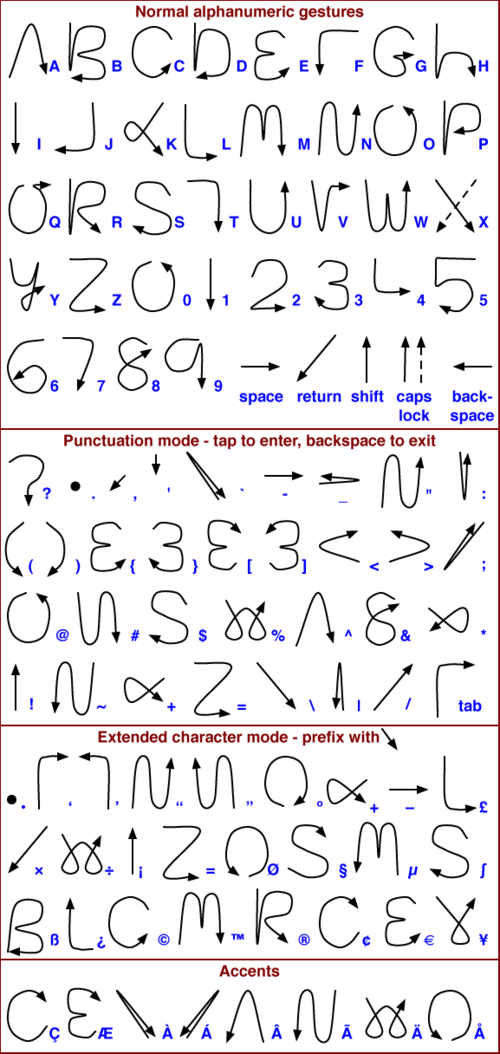
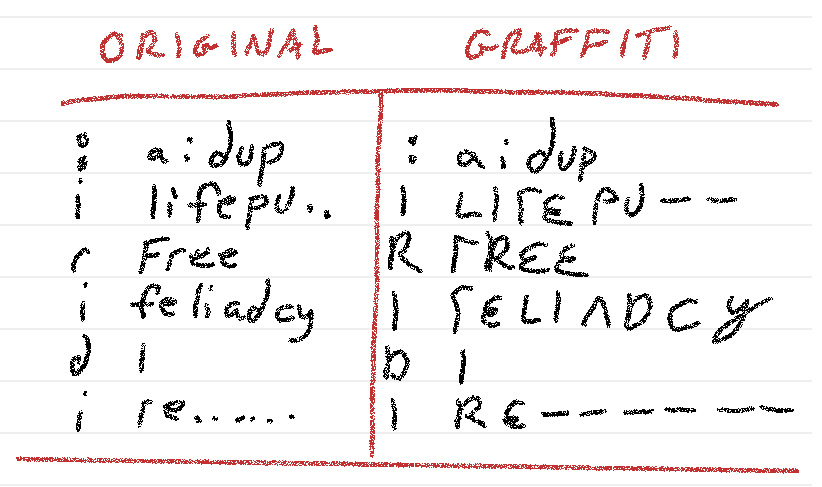
Thinking back to the days when I used PDAs, I started using Palm's Graffiti to simplify the strokes. This helped, though less so than I'd hoped.
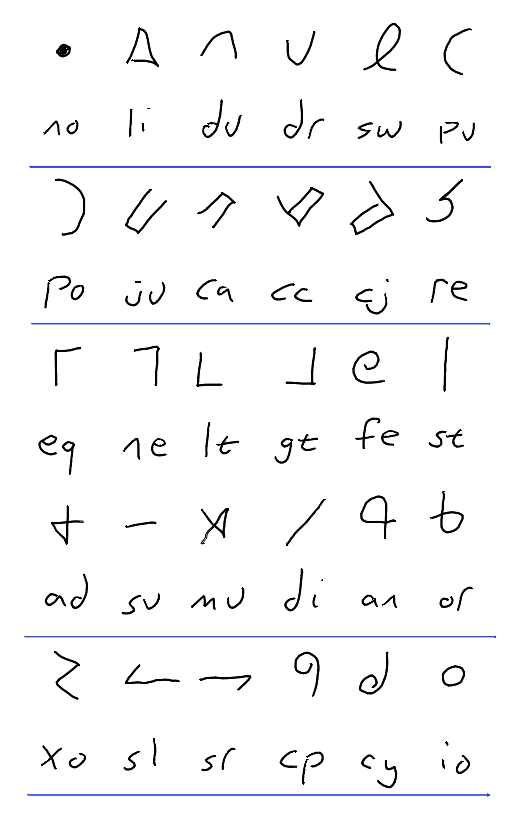
As I continued, I began to consider that I could just create my own alphabet, and assign a unique glyph to each of the instructions. I began sketching out ideas on this, and eventually settled on the a set of single stroke glyphs that I liked. Since ilo and konilo derive their naming from toki pona, I named this sitelen ilo. I found this to be helpful in reducing the pain from my writing, and as I worked with it, I began to write out the assembly differently.
I put together some templates for the Supernote and reMarkable, which laid out a set of boxes for labels, instruction tetrads, and references. This made the code on page more compact, and with the symbols, I found that it also made it easier for me to see patterns in the code. This has been my primary way to write out and mentally map or explore my code now.
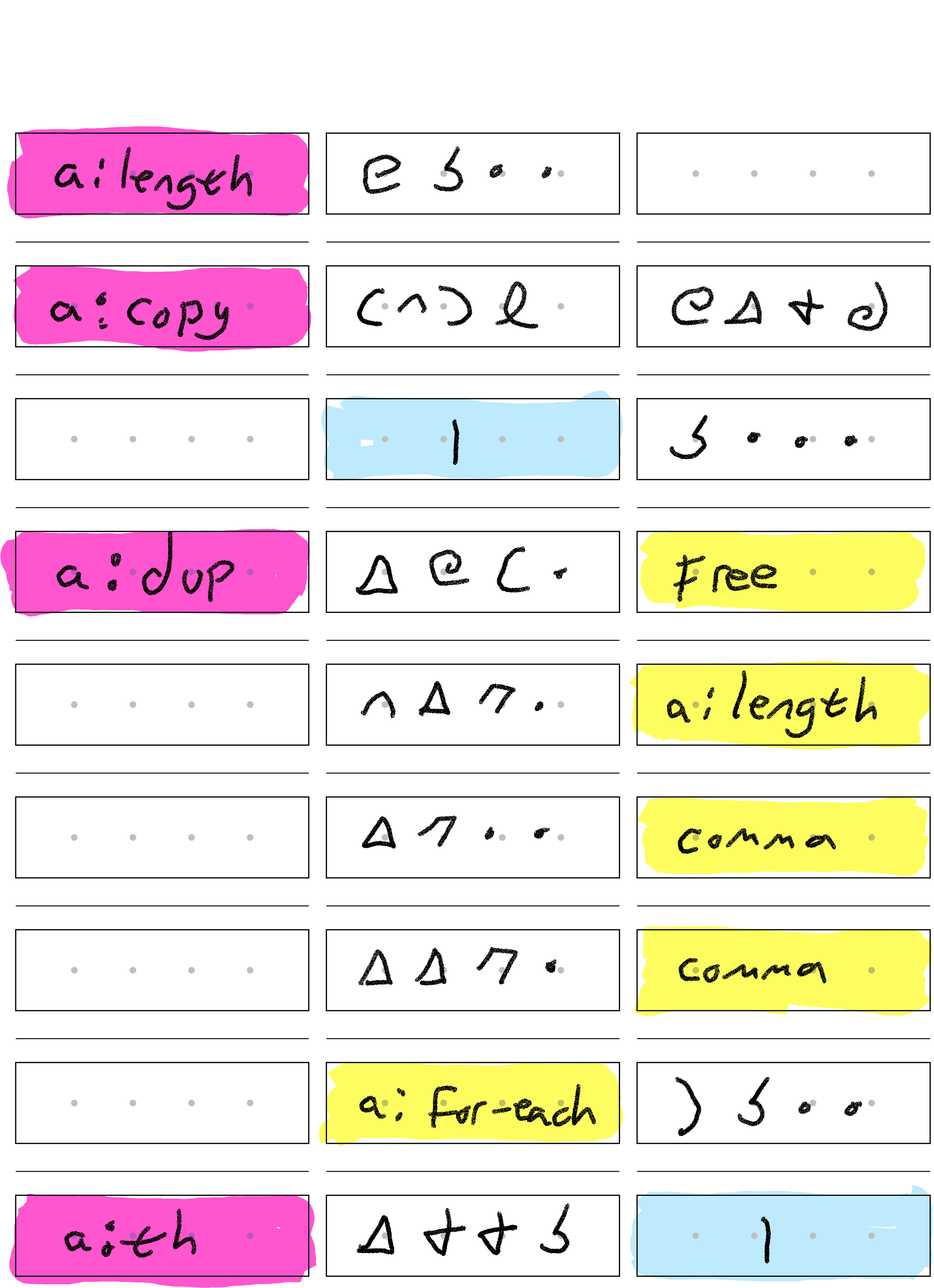
Since December 2025, I wrote some (currently unpublished) tools to take an ilo assembly program formatted for the pali assembler and generate HTML in a format similar to my handwritten structure. Some examples include konilo, uxn, and poraka. I don't know if sitelen ilo is actually useful for anyone other than me, but it's become an important part of how I work on my assembly projects and I expect to continue using and refining it over time. It's likely that some of the glyphs may change a little to make them more visually distinctive, though the similarities do force me to take a little more time in writing out my code, which gives me longer to think about what I'm writing.
Following ilo's ISA, instructions are bundled into tetrads, with four instructions in each. These are read from left to right. An instruction bundle like puduposw becomes:
Learning to read this requires learning the 30 ilo instructions, and mentally mapping the glyphs to the instructions. For me this wasn't hard, though it did take a little time before I was able to fluently write it out.
If trying to read out loud, that's more difficult. I currently read it as if it were written using the two character instruction names, but am considering assigning sounds to each to see if I can work out a meaningful audible structure for the language. This is, for me, much more difficult than learning the glyphs was. But it'd be useful to be able to record code bits for later transcription, or perhaps in a "speech to text" tool in the future.